You've reviewed the client's data. Weight's down. Adherence is solid. Everything looks good.
Now you're staring at a blank message box. What do you actually say?
"Great work, keep it up!" feels generic. But writing something personal for 30 clients takes forever. And honestly, sometimes you just don't know what to say.
Here's the truth: the check-in message is where coaching happens. It's not the workout program. It's not the macro plan. It's the 3-sentence note that makes a client feel seen, celebrated, or supported when things go sideways.
This article gives you 5 copy-paste templates for the most common check-in scenarios. Use them as-is, or tweak them to match your voice. Either way, you'll never stare at a blank message box again.
Why the Message Matters (It's Not Just Data)
Let's get clear on what a check-in message actually does.
It's not a data readout. You don't need to say "You weighed 152.4 lbs this week, down from 153.1 last week." They know that. They submitted it.
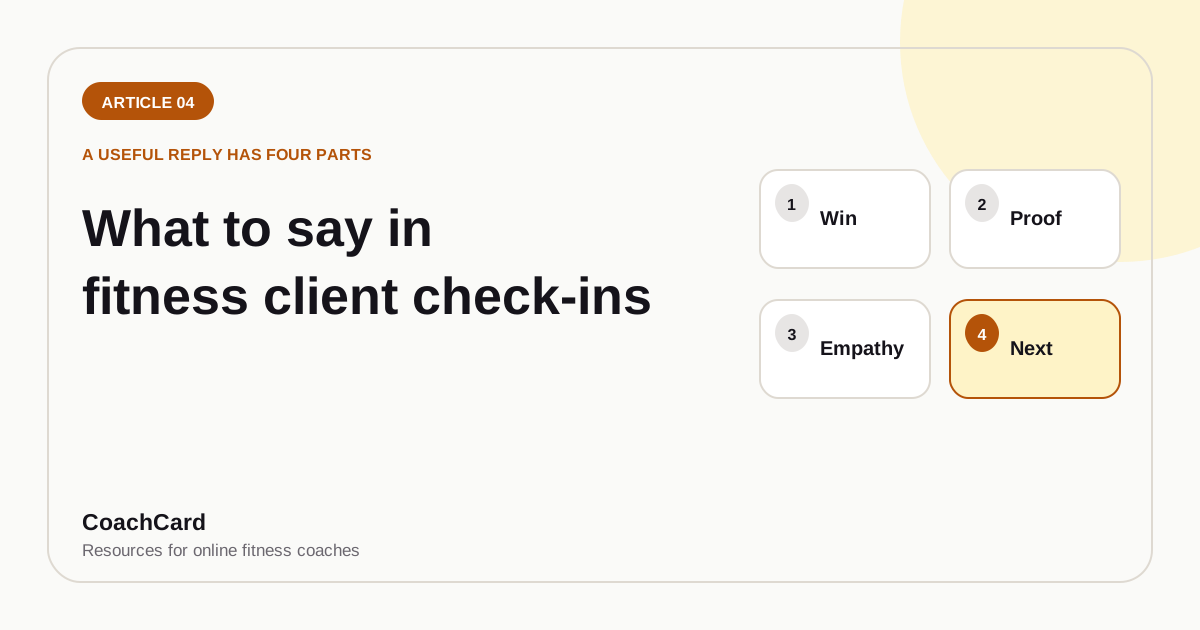
It's encouragement + direction. Your job is to:
- Highlight the win (even if it's small)
- Anchor it in data (proof this is real)
- Acknowledge challenges (if they exist)
- Set the focus for next week
That's it. Four pieces. 3-5 sentences. Takes 60 seconds to write if you have a structure.
The 4 Parts of an Effective Check-In Message
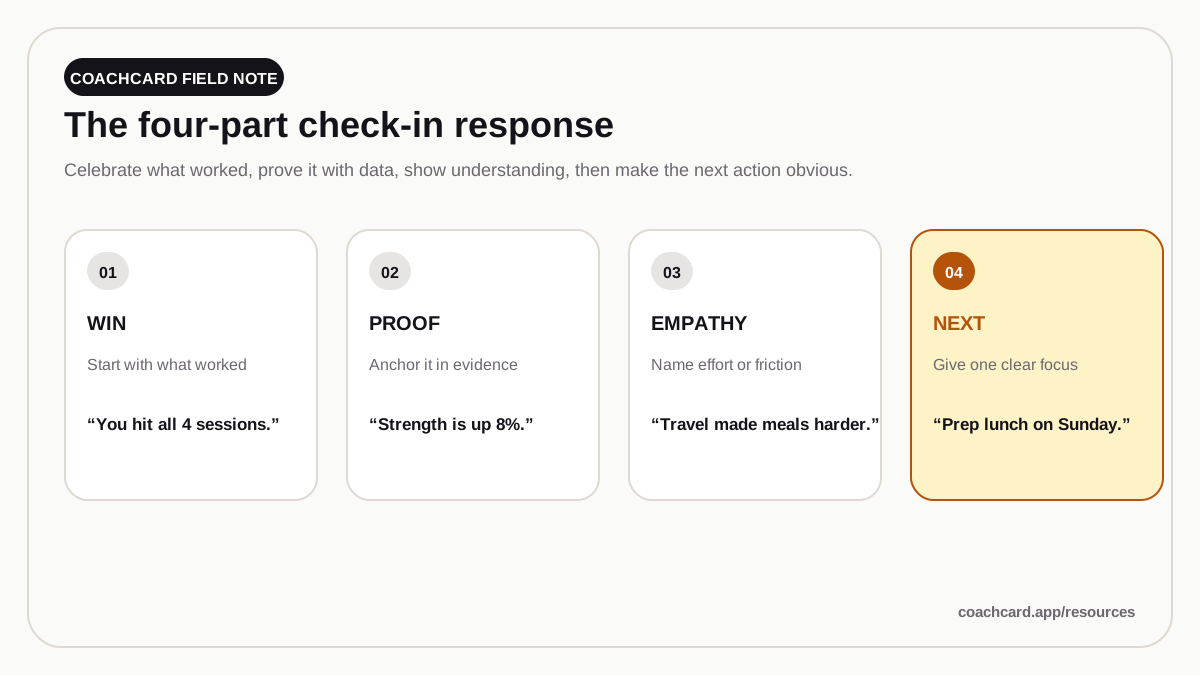
Before we get to the templates, here's the anatomy of a check-in message that works:
1. Lead with the win
Every week has a win. Even "bad" weeks. Find it and name it first.
Why? Because humans remember the first thing they read. If you lead with "Weight's flat this week," that's what sticks. If you lead with "You hit 5/5 workouts," that's what they remember.
2. Reference the numbers (proof)
Don't just say "You're doing great." Say why they're doing great, using their data.
"Waist is down 0.8 inches" is proof. "Adherence was perfect this week" is proof. Proof makes praise feel earned, not empty.
3. Acknowledge effort or challenges
If they struggled, don't pretend it didn't happen. If they crushed it despite a hard week, name that effort.
"I know you said work was crazy this week, and you still hit 4/5 workouts. That's discipline."
4. Set next week's focus
Don't just say "keep going." Give them one clear thing to focus on.
- "This week, let's aim for 5/5 workouts again and keep protein above 140g."
- "This week, I want you to notice how your clothes fit. The scale's being stubborn, but I think you'll feel a difference."
One focus. Clear direction. That's how you keep momentum.
5 Copy-Paste Message Templates (For Every Scenario)
Template 1: Weight Loss Progress (Everything's Working)
When to use: Client lost weight, adherence is good, metrics are moving in the right direction.
Template:
[Name], this is exactly what we want to see. Weight down [X lbs], waist down [X inches], and [X/X] workouts completed. Your body is responding perfectly to the plan.
The adherence this week was [great/solid/on point] — that's what's driving these results. Keep doing exactly what you're doing.
This week: Same plan, same focus. Let's aim for [X/X workouts] and keep the momentum going.
Real example:
Sarah, this is exactly what we want to see. Weight down 1.2 lbs, waist down 0.6 inches, and 5/5 workouts completed. Your body is responding perfectly to the plan.
The adherence this week was on point — that's what's driving these results. Keep doing exactly what you're doing.
This week: Same plan, same focus. Let's aim for 5/5 workouts and keep the momentum going.
Template 2: Strength Gains (Weight Flat, Performance Up)
When to use: Weight hasn't changed much, but they're getting stronger or hitting new PRs.
Template:
[Name], the scale might not have moved this week, but your performance did — and that's what matters. [Specific strength gain: e.g., "10 more lbs on squats" or "2 extra reps on bench"].
This is body recomposition. You're building muscle and losing fat at the same time, which is why the scale stays flat. But your body is changing — trust the process.
This week: Keep pushing in the gym. The scale will catch up, but strength gains are the real progress marker right now.
Real example:
Mike, the scale might not have moved this week, but your performance did — and that's what matters. You added 15 lbs to your squat and hit 8 reps on bench instead of 6.
This is body recomposition. You're building muscle and losing fat at the same time, which is why the scale stays flat. But your body is changing — trust the process.
This week: Keep pushing in the gym. The scale will catch up, but strength gains are the real progress marker right now.
Template 3: Plateau Week (No Change in Metrics)
When to use: Weight, measurements, and performance are all flat. Nothing moved.
Template:
[Name], this week was flat — weight and measurements stayed the same. That happens, and it's not a problem. Here's why:
[Pick the most likely reason: water retention, hormones, stress, sodium, etc.]. The trend over the last [2-4 weeks] is still [down/up/on track], which tells me we're moving in the right direction.
This week: No changes to the plan. Let's give it one more week at this pace and reassess. Sometimes your body needs a week to catch up.
Real example:
Emma, this week was flat — weight and measurements stayed the same. That happens, and it's not a problem. Here's why:
You mentioned you had a restaurant meal Saturday, which usually means more sodium and water retention. The trend over the last 3 weeks is still down 2.4 lbs, which tells me we're moving in the right direction.
This week: No changes to the plan. Let's give it one more week at this pace and reassess. Sometimes your body needs a week to catch up.
Template 4: Tough Week (Adherence Slip)
When to use: They missed workouts or fell off the nutrition plan. Don't shame them — acknowledge and redirect.
Template:
[Name], I see this week was tough — [X missed workouts / adherence dropped / whatever happened]. It happens. Life doesn't pause for a training plan.
The important thing is you're showing up and checking in, which means you're still committed. That's what matters most.
This week: Let's simplify. [Specific adjustment: e.g., "Let's aim for 3 solid workouts instead of 5" or "Focus on protein at each meal, forget the rest"]. We'll build back from here.
Real example:
Jake, I see this week was tough — only 2/5 workouts completed and protein was low most days. It happens. Life doesn't pause for a training plan.
The important thing is you're showing up and checking in, which means you're still committed. That's what matters most.
This week: Let's simplify. Aim for 3 solid workouts (Monday, Wednesday, Friday) and hit 120g of protein. That's it. We'll build back from here.
Template 5: Big Milestone (10 lbs down, strength PR, body comp win)
When to use: They hit a major milestone. Celebrate it.
Template:
[Name], THIS is a win. [Specific milestone: "You just hit 10 lbs down" or "New PR on deadlifts" or "Waist is down 2 inches total"]. This is what all the work has been building toward.
Take a second to appreciate this. [X weeks/months] ago, you couldn't [specific comparison]. Now look at you.
This week: Let's keep the momentum. [Next mini-goal or focus]. You've earned this — let's keep it going.
Real example:
Lisa, THIS is a win. You just crossed the 10 lb mark — 10.4 lbs down in 8 weeks. This is what all the work has been building toward.
Take a second to appreciate this. 8 weeks ago, you were struggling to hit 3 workouts a week. Now you're 5/5 consistently and the results are showing.
This week: Let's keep the momentum. Next mini-goal is 12 lbs by end of month. You've earned this — let's keep it going.
The Tone Mistake: Too Clinical vs Too Cheerleader
There's a balance to strike here. Two extremes coaches fall into:
Too clinical: "Body weight decreased 0.8 kg this tracking period. Adherence rate: 80%. Continue current protocol."
Sounds like a robot. Clients want a human, not a lab report.
Too cheerleader: "OMG YOU'RE AMAZING!!! KEEP CRUSHING IT QUEEN!!! 🔥💪🎉"
Sounds fake. And exhausting to read every week.
The sweet spot: Warm, direct, evidence-based. Celebrate wins without over-the-top hype. Acknowledge struggles without catastrophizing.
Think: supportive coach, not hype man. Data-driven, not robotic.
How AI Can Draft These for You
Here's the secret: you don't have to write these from scratch every time.
Tools like CoachCard use AI to draft personalized check-in messages based on your client's data. The AI analyzes the numbers, identifies the key takeaway (progress, plateau, setback), and writes a message in your style.
You review it, tweak if needed, and send. Takes 30 seconds instead of 3 minutes.
The AI handles structure and tone. You add the human touch. Best of both worlds.
Never Stare at a Blank Message Again — Try CoachCard
CoachCard writes personalized check-in messages for you using AI. Review 30 clients in under an hour.
→ Try CoachCard free — no card required
The Bottom Line
Writing check-in messages doesn't have to be hard. You need a structure, a few templates, and the discipline to lead with the win every time.
Use these 5 templates as your foundation. Adjust the tone to match your voice. And remember: the message is the coaching. The data is just proof.
When you make clients feel seen, celebrated, and supported — that's what keeps them coming back. That's what retention looks like.